What Does a Blower Door Test Do?
Colorado’s Front Range swings hard between warm afternoons and cold nights, and altitude alone makes a leaky house work harder to hold heat than it would at sea level.
If your monthly bills keep climbing, you feel drafts near the windows, or your floors stay cold no matter what the thermostat says, those aren’t separate problems. They’re usually symptoms of the same thing: your home losing conditioned air faster than it should. A home energy professional treats your house as one connected system, not a pile of separate rooms. The blower door test turns “it feels drafty” into a real number.
REenergizeCO includes the blower door test in every complete home energy audit for homeowners in Denver, Fort Collins, and across the Front Range. What follows walks through exactly what the test does, what the numbers mean, and what it costs.
What Is a Blower Door Test?
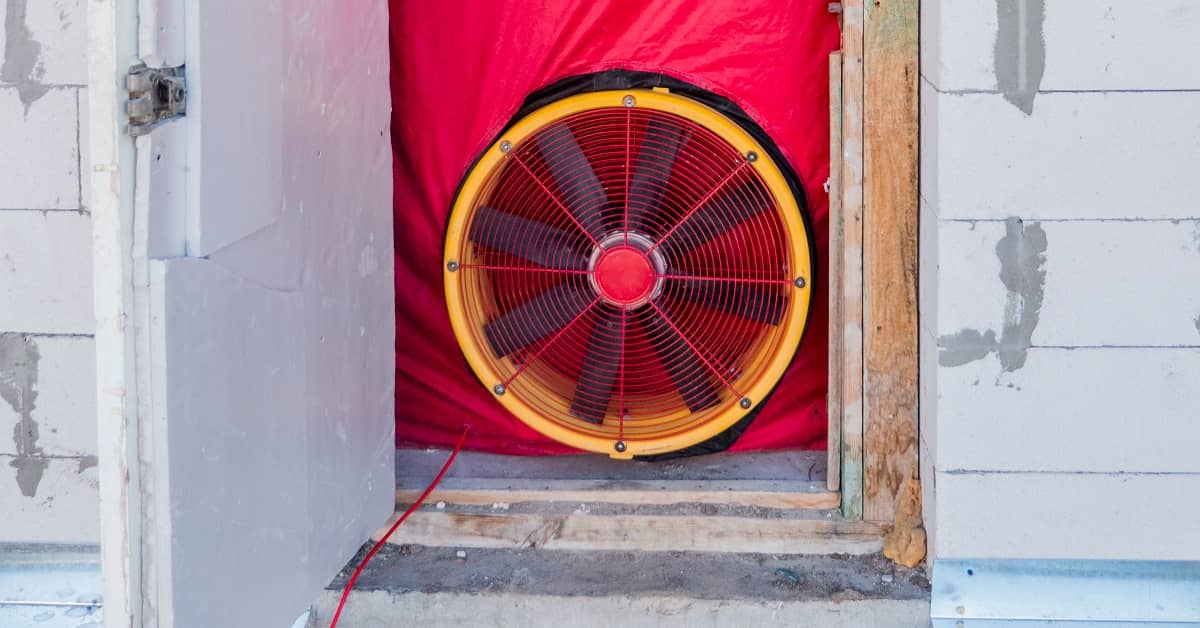
A blower door test measures how much outside air your home trades with the outdoors every hour. A calibrated fan mounts in a covered frame that fits an exterior doorway or window, draws inside air outdoors, and holds the building at a specific pressure difference. Calibrated gauges monitor that pressure change throughout the house. The more pressure the fan must generate to maintain that difference, the more air is leaking through the building envelope.
The testing equipment includes a manometer accurate to 0.5 Pa with 0.1 Pa resolution, precise enough to catch envelope leakage that no draft check or visual inspection would find. The fan’s airflow reading at 50 pascals of pressure is called CFM50 (cubic feet per minute at 50 pascals). That’s the raw measurement. One pascal equals one newton per square meter, which gives you a sense of how fine the pressure difference actually is.
From CFM50, the energy auditor calculates ACH50: air changes per hour at 50 pascals. ACH50 tells you how many times per hour your home’s entire air volume is replaced by outside air when the building is held at that standard test pressure. The formula is straightforward:
ACH50 = (CFM50 x 60) / building volume in cubic feet
CFM50 and ACH50 are the two results that matter to building codes and certification programs. RESNET and ASTM standards both provide guidance for producing them, and programs like ENERGY STAR and DOE’s Zero Energy Ready Home use them as air tightness benchmarks. The test isn’t pass/fail on its own. It produces a number your auditor can compare against a real standard for your climate zone, so “drafty” becomes a figure you can actually work with.
Colorado’s Front Range sits in IECC Climate Zone 5, which carries tighter air leakage targets than milder regions. A new home built to current building code must hit 3 ACH50 or better. Many older Denver houses test at 8, 10, or higher. New construction in Colorado must meet that same 3 ACH50 threshold to comply with code requirements.
That gap isn’t just a number on a report. It’s the difference between a furnace that cycles normally and one that runs almost continuously on a January night when temperatures drop into the single digits. Knowing your ACH50 tells you exactly how far your home sits from that code target and how much room there is to improve.
What Happens During a Blower Door Test?
The visit itself is simpler than most homeowners expect. The auditor starts by walking through the house with you, discussing problem areas: drafty exterior doors and windows, rooms that never hold indoor temperature, spots where cold air seems to come up through the floor. You don’t have to leave. You can walk the house with the auditor while the fan runs, which is often when the most useful conversation happens.
Before the fan goes in, a few quick steps make the test accurate. Closed windows, open interior doors, and extinguished fireplace embers are the three that matter most on blower door day. For the full preparation checklist, preparing for an energy audit covers every item in detail.
If your home has combustion appliances that draw indoor air, such as a gas furnace, a water heater, or a fireplace, a thorough auditor adds one more step before the blower door runs.
It’s called a Worst Case Depressurization Test. It checks pressure conditions in the Combustion Appliance Zone to confirm the pressurization test itself won’t create a backdrafting risk. Backdrafting is what happens when a depressurized building pulls combustion gases back down the flue instead of letting them exhaust outside.
If that check shows a potential problem, remediation happens first, and the blower door test waits. A qualified auditor also carries a gas sniffer and a carbon monoxide sensor, so the safety check covers gas leaks and incomplete combustion alongside the pressure differential measurement. Most homeowners never hear about this step, but it’s part of a complete, professional assessment.
That combustion safety check matters more in Colorado than in many other states. Homes at altitude already operate under lower barometric pressure, which affects how combustion appliances draft. A gas furnace or water heater that vents correctly at sea level can behave differently at 5,280 feet.
An auditor who skips the Worst Case Depressurization Test in a Denver home isn’t just cutting a corner on paperwork. They’re skipping the one check that confirms the blower door fan itself won’t create a hazardous condition in your mechanical room. It’s a short test, and it’s non-negotiable on a professional assessment.
What a Blower Door Test Reveals About Your Home
Once the fan runs and the blower door test results are in, the auditor has four things your thermostat can’t tell you:
- How well your home is sealed against outside air and how that compares to a target for your climate zone
- Where the likely air leaks are: around doors and windows, at the foundation, in the attic, around fixtures and appliances
- How air moves through the home, including whether conditioned air is escaping through paths you’d never think to check
- How well insulation performs, since insulation laid over unsealed leaks can’t do its job fully
Here’s the scale that makes those four points land. If you added up all the leaks, holes, and gaps in a typical home’s building envelope, it would be like having a window open every day of the year. That’s not a metaphor for “somewhat leaky.” That’s the actual aggregate air leakage area in a building that hasn’t been air-sealed.
EPA models a cost-effective air sealing project, focused on the attic, foundation, and around windows and doors, as achieving roughly a 25% reduction in total air infiltration. Air sealing combined with insulation can save an average of 15% on heating and cooling costs, or about 11% on total energy costs. Those are government-modeled figures, not a contractor’s estimate.
Most homeowners develop a good sense of which rooms run hot or cold. That instinct is real, but it only gets you so far. It can’t tell you whether the problem is at the foundation, in the attic, or in the wall framing, and it can’t tell you how much air-sealing improvement is realistic. The blower door test can. The before-and-after CFM50 reading is also the exact measurement Xcel uses to verify air sealing improvements, which matters when you get to the cost section below.
What the test also reveals, and what surprises most homeowners, is how much leakage comes from places that aren’t obvious.
- Recessed light cans in an attic floor are a common culprit.
- So are the gaps where plumbing and electrical outlets and lines pass through top plates into the attic.
- A rim joist where the floor framing meets the foundation wall is another.
- Spray foam is the material most auditors reach for to seal those rim joist gaps, because it fills irregular cavities and creates a continuous air barrier in a single step.
None of these show up on a visual walkthrough. The blower door depressurizes the whole building at once, so air rushes in through every gap simultaneously. That’s what makes it so much more useful than checking individual spots by hand.
Poor indoor air quality is another consequence of uncontrolled air leakage, since gaps that let conditioned air out also let in dust, allergens, and moisture that forced-air heating systems then circulate through the house.
What Does a Blower Door Test Cost?
The short answer: you won’t get a standalone bill for a blower door test. It’s bundled into a full home energy audit rather than sold as a separate line item. Here is what you will pay for a Home Energy Audit after the rebate, which includes the blower door test:
- $135 – Xcel electric & gas/electric heat customers
- $175 – Xcel electric only (gas/heat from another company)
- $60 – Efficiency Works electric or gas customers (includes Estes Park, Fort Collins, Longmont, Loveland utilities)
- $335 – Other providers (check for possible rebates)
The blower door test also connects directly to Xcel’s air sealing rebate, which covers up to 30% of project cost up to $200. That rebate requires proof of at least a 20% reduction in CFM50, the same fan-flow measurement the blower door produces. Without a before-and-after blower door reading, there’s no way to document that reduction and no rebate.
Think of the audit cost this way: the rebate-eligible portion of the blower door tier brings your out-of-pocket cost for the diagnostic step down to a fraction of what you’d spend on a single service call for a furnace tune-up.
And unlike a tune-up, the audit produces a prioritized list of improvements with documented savings potential. The audit isn’t an expense that competes with the upgrades. It’s the step that tells you which upgrades are worth doing and in what order, so you don’t spend money on insulation before you’ve sealed the leaks that would undermine it.
On the credential side, contractors performing enclosure testing must be certified through BPI or a RESNET-approved home performance certification program. That requirement exists because the test involves depressurizing your home, running combustion safety checks, and interpreting results against building science standards. It’s not a DIY procedure, and a non-certified contractor can’t produce results that satisfy Xcel’s rebate documentation requirements.
Your ACH50 Number Is the Starting Line, Not the Finish
A leaky house in Denver isn’t a comfort problem you learn to live with. It’s a measurable gap between where your home is and where it could be, and the blower door test is what closes that gap on paper before the work closes it in the walls.
The blower door test is exactly that. It converts a vague sense that something is wrong into a CFM50 reading, a climate zone comparison, and a ranked list of fixes with documented payback. That’s how you save money on heating, not by guessing at which door frame to caulk, but by knowing your actual air changes per hour and working down from there.
The sequence matters. Seal first, then insulate, then right-size the equipment.
Doing it out of order costs money twice: once on insulation that can’t perform over unsealed leaks, and again on equipment sized for a house that no longer exists after the envelope work is done.
Ready to turn your home’s ACH50 number into a real action plan?
Call REenergizeCO in Denver at (303) 227-1000 or Fort Collins at (970) 323-3191 to schedule your home energy audit before the cold snap hits and the calendar fills.
Share on:
Get In Touch
By submitting this form, you consent to receive emails from REenergizeCO. You can unsubscribe at any time by clicking the link in the footer of our emails. Emails are serviced by Constant Contact.
Related Posts

What Is a Home Energy Audit and How Do You Prepare?
Articles on Energy SavingMost homeowners book an energy audit because a room is cold. They keep the appointment because of what Xce…
Read More »
10 Colorado Winter Energy-Saving Tips for Our Climate
Articles on Energy SavingIn preparation for winter, we encourage you to follow some of these energy saving tips during Energy Actio…
Read More »
Insulate First to Maximize Your Xcel Heat Pump Rebate
Energy Audit ArticlesMaximize your Xcel heat pump rebate! Learn why insulating your attic first is crucial for Colorado homeown…
Read More »